About Walton Manor
Planning
Guidance on Planning Issues
The Planning Framework
The National Planning Policy Framework sets out the government’s planning goals and policies for England and how they are expected to be applied by local authorities. The national planning goals provide a steer for Local Planning Authorities (LPA’s) when they formulate their Local Plans. Oxford Local Plan sets out a vision for the city from now until 2036. It contains a large number of policies that are used by the council to guide development.
The National Planning Policy Framework requires councils to protect heritage assets through the listing of buildings that have special architectural merit and the designation of conservation areas for areas that have a distinctive architectural character. Section 6 of the Oxford Local Plan, Enhancing Oxford’s heritage and creating high quality new development, sets out the councils approach and policies in relation to the protection of heritage assets. Policy DH1 and DH3 are particularly relevant to Walton Manor residents:
Policy DH1 states that ‘planning permission will only be granted for development of high quality design that creates or enhances local distinctiveness’.
Policy DH3 states that ‘planning permission or listed building consent will be granted for development that respects and draws inspiration from Oxford’s unique historic environment (above and below ground), responding positively to the significance character and distinctiveness of the heritage asset and locality’ (in this case the conservation areas.
Living in the Walton Manor Residents Association Area (WMRA)
All the properties within the boundaries of the WMRA area fall within either the North Oxford Victorian Suburb Conservation Area or the Walton Manor Conservation Area

Conservation areas exist to protect the special architectural and historic interest of a place. Oxford City Council has published an appraisal of the North Oxford Victorian Suburb Conservation Area Appraisal. The council are due to undertake an appraisal of the smaller, Walton Manor Conservation Area Appraisal in the near future,
People value conservation areas for their distinctiveness, visual appeal and historic character and research has found that this value is reflected in the price of properties in conservation areas. Generally they cost more and appreciate in price more than properties in other areas.
Within our conservation areas there are also a large number of listed buildings.
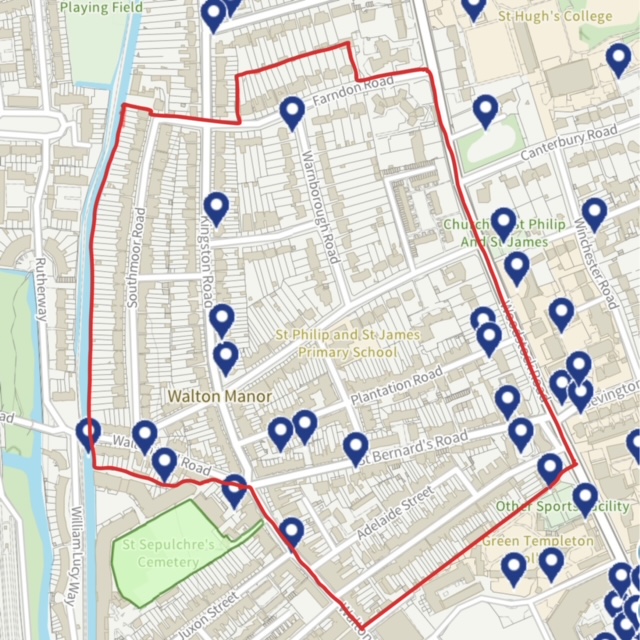
These buildings, some of which are houses, have been identified as being of special architectural interest and receive additional protection under planning legislation.
How living in a conservation area can affect you
Although conservation areas mean some extra planning controls and considerations, these exist to protect the elements that make our area so special. The planning controls in place for different types of heritage asset are as follows:
A. Listed Buildings
Owners of listed buildings are likely to need Listed Building Consent for any alterations or additions, whether internal or external, in addition to planning consent.
B. Trees
Trees within our area are also protected because they contribute significantly to the character of Walton Manor. You need permission to carry out any works to a tree that has a stem diameter of 75 millimetres or more measured at 1.5 metres from ground level. Works include:
- Cutting down
- Uprooting
- Topping
- Lopping
- Wilful damage or wilful destruction
Applications can be made online at: https://www.oxford.gov.uk/info/20198/trees_woodlands_and_hedges/697/trees_in_conservation_areas.
There is a maximum penalty of £20,000 for carrying out works to TPO trees without consent.
The Oxford City Council’s Tree Officer can be contacted at: https://www.oxford.gov.uk/info/20198/trees_woodlands_and_hedges/697/trees_in_conservation_areas
C. Dwellings
If you live in a conservation area and want to demolish your building you will need Planning Permission. However, if you wish to make additions or alterations to your house you may or may not require planning permission. National legislation sets out Permitted Development Rights that allows house owner to make certain alterations and additions to their houses without the need for planning permission. However, permitted development rights are slightly curtailed for properties in conservation areas. This means that you need to make planning applications for some forms of development that would not need such applications outside conservation areas.
Here are examples of the type of changes that you might want to make to your house and whether or not they will need planning permission:
TYPE OF CHANGE |
PLANNING PERMISSION |
Repairs and maintenance |
|
Repairs – if undertaken in a like-for-like manner. |
NO |
Maintenance. |
NO |
Roofs |
|
Raising the ridge/ expanding the size of a roof |
YES |
Installing a dormer window |
YES |
Renewing or replacing a roof covering |
MAYBE |
Installing solar panels |
YES |
Installing a roof light |
YES |
Walls |
|
Cladding |
YES –unless repairing or renewing an existing surface |
Satellite dishes |
YES on an elevation fronting a highway or on a chimney |
Installing, altering or replacing a chimney, flue soil or vent pipe on a wall or roof on a principal or side elevation fronting a highway |
YES |
Windows and Doors |
|
Replacement windows – ‘like for like’ timber single glazed sash windows. |
NO |
Replacement windows – timber double glazed or uPVC. |
YES |
Draught proofing and refurbishing windows. |
NO |
Replacing single glazed sashes with double glazed sashes. |
MAYBE |
Extensions and ancillary buildings |
|
Front, side and two storey rear extensions |
YES |
Sheds, Garden Buildings, bin or cycle stores. |
YES - in front gardens MAYBE elsewhere depending on size and location. |
Single storey rear extensions. |
YES |
Boundaries |
|
Demolition of walls, fences and railings – if over 1 metre fronting a highway, or over 2 metres elsewhere. |
YES |
Construction of walls, fences and railings – if over 1 metre fronting a highway, or over 2 metres to the side or rear of a property. |
YES |
Railings on walls - if the height of the wall is brought above 1 metre fronting a highway, or 2 metres elsewhere. |
YES |
Gardens and yards |
|
Works to trees - trees with a trunk/stem diameter greater than 75mm as measured at 1.5 metres from ground level. |
YES |
Surfacing and ground works. |
MAYBE depending on scale and form of operation. |
Garden ornaments/ planting/ maintenance. |
NO |
NB. This list is not exhaustive. |
|
Who do I ask about changes?
Oxford City Council planning officers can help you if you are unclear whether or not you require planning permission. The planning team can be contacted at:
Planning Team
Oxford City Council
Town Hall
St Aldate's
Oxford
OX1 1BX
Telephone: 01865 249811
Email:planning@oxford.gov.uk
If you telephone please ask for the Duty Planning Officer or the Case Planning Officer if you want to talk about an existing planning application.
How do I submit a planning application?
Planning applications can be submitted online via the Oxford City Council Website. The documents required for a submission are also detailed on the website. A fee is payable for submitting a planning application. It normally takes two to three months for an application to be considered.
If you want written confirmation that the alterations or additions that you are intending to make to your property are lawful you can apply for a Certificate of Lawful Development.
How are applications assessed?
Planning applications are assessed by a Delegated Planning Officer or sometimes by the Planning Committee to ensure that the proposals conform to national planning legislation (i.e. permitted development legislation) and the relevant policies contained in the Oxford Local Plan 2036 , particularly policies DH1 and DH3.
It is up to the applicant to demonstrate that their proposals align with the legislation and local planning policies.
Can I appeal if my application is declined?
Yes, you can appeal via the Oxford City Council website if your application is declined. Appeals against the refusal of a planning application must be submitted:
- 12 weeks from the date of the decision for householder developments
- 6 months from the date of the application decision letter for all other developments
My neighbours are building something without planning permission, what should I do?
Please contact the City Council’s Planning Enforcement Team and they will investigate whether there is a breach of planning control. You can find their contact details on the Planning Enforcement webpages.